
Deploy with Confidence
Ensure your protection schemes are reliable, secure, and optimized before they ever reach the substation. Our realtime digital simulation platform rigorously tests Intelligent Electronic Devices (IEDs) under every conceivable fault and operating condition—within a safe, virtual environment. This approach derisks deployment, accelerates commissioning, and guarantees maximum performance in both conventional and digital substations.
Solution Benefits
-
Realistic validation Observe how relays and the power system behave in real time under realistic operating conditions.
-
Faster commissioning Test and refine protection schemes virtually before going live.
-
Seamless interoperability Verify that hardware and software from different vendors work smoothly together.
-
Futureproof testing Evaluate new protection algorithms even if the physical hardware is not yet available.
-
Versatility Support both traditional relays and advanced smart grid technologies.
-
Reliability assurance Gain confidence in relay performance through thorough factory testing before installation.
Hardware in the Loop (HIL) Testbed for Protection Devices
Simulated Electrical Network - Conventional Substation
In a HIL testbed, our RTSim platform generates voltage and current signals that emulate those from instrument transformers.
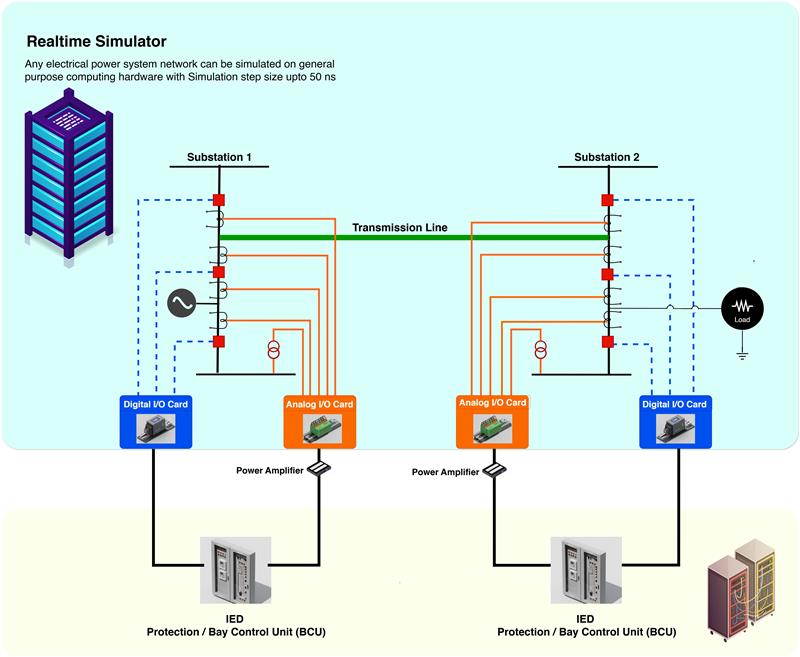
Signal Emulation
- IEDs (Protection and Bay Control Units) receive analog voltage signals at standard secondary levels (e.g., 230/110 V AC from PTs).
- They also receive standard secondary analog currents (e.g., 1 A / 5 A from CTs).
Signal Conditioning
- RTSim’s analog output cards operate within a nominal ±10 V peak range.
- To drive conventional IEDs and Merging Units at standard secondary levels, outputs are connected to external power amplifiers.
- If the IED supports a “lowlevel” interface, RTSim outputs can be connected directly.
Closed Loop Testing
- Protective IEDs under test respond to simulated faults by generating trip and reclose signals.
- These signals are fed back into RTSim, which updates the state of circuit breakers modeled in the realtime power system simulation.
- This closed loop ensures accurate validation of protection logic under realistic fault conditions.
Why It Matters
By combining realtime simulation with hardwareintheloop testing, you can
- Validate protection schemes before deployment.
- Reduce risks and costs associated with field testing.
- Ensure interoperability across multivendor environments.
- Optimize system reliability for both conventional and digital substations.