

Wide-Area Monitoring, Protection, and Control (WAMPAC) systems are essential for maintaining grid stability, detecting disturbances, and responding to emergencies across large geographic regions. Hardware-in-the-Loop (HIL) simulation offers a safe, efficient, and comprehensive way to test these systems—by connecting real PMUs and control hardware to a high-fidelity, real-time digital model of the power grid in RTSim.
This approach enables closed-loop testing of WAMPAC algorithms, Phasor Measurement Units (PMUs), Phasor Data Concentrators (PDCs), and protection relays under realistic operating conditions—without the risks or limitations of field testing.
Solution Benefits
-
PMU Validation Test synchrophasor accuracy, latency, and compliance with IEEE standards.
-
PDC Performance Testing Validate data alignment, loss recovery, and multi-source aggregation logic.
-
WAMPAC Algorithm Verification Test control logic for oscillation damping, islanding detection, and wide-area protection schemes.
-
Grid Disturbance Replay Reproduce historical blackout scenarios or synthetic events for forensic analysis and algorithm tuning.
-
Cybersecurity Assessment Evaluate system resilience against spoofing, data injection, and communication failures.
-
Safe scenario testing Simulate blackouts, cascading failures, and cyberattacks without risking equipment or personnel.
-
System reliability enhancement Reproduce diverse power system scenarios to validate WAMPAC logic and improve grid resilience.
-
Multi-vendor interoperability Verify seamless operation of PMUs, PDCs, and relays from different manufacturers within a unified WAMPAC framework.
Hardware-in-the-Loop (HIL) Testing for Wide-Area Monitoring & PMU Systems
HIL simulation enables engineers to validate PMUs, Phasor Data Concentrators (PDCs), and WAMPAC algorithms by connecting them to a real-time digital twin of the power grid in RTSim. This allows safe, repeatable testing of system behavior under realistic conditions—such as faults, oscillations, and cyberattacks—without risking physical infrastructure.
Simulated Electrical Network - Wide Area Monitoring, Protection and Control (WAMPAC)
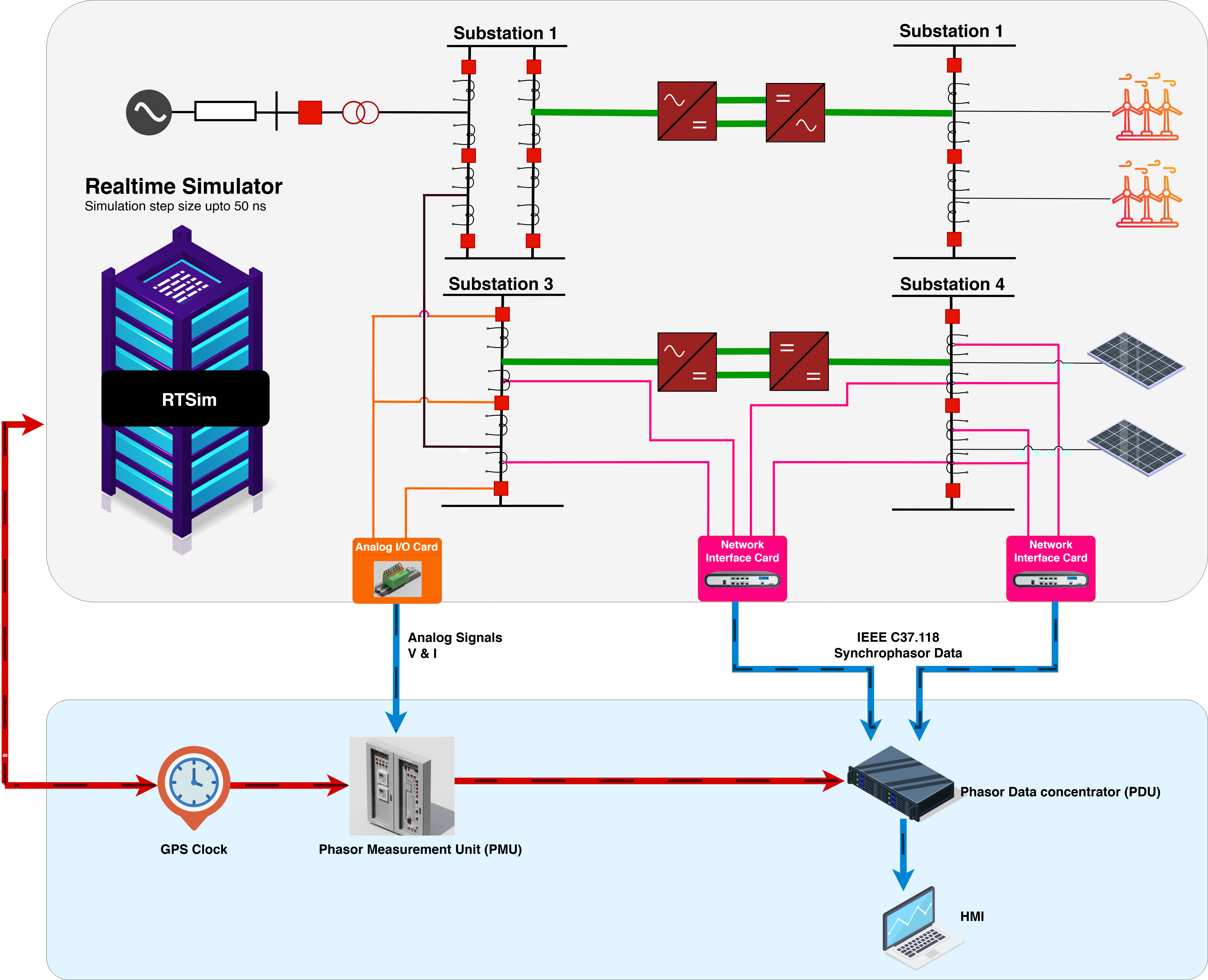
PMU Signal Injection
- RTSim generates real-time voltage and current waveforms that mimic grid conditions.
- These are fed into the PMU via analog interfaces or digital protocols (e.g., IEC 61850-9-2 Sampled Values).
- The PMU computes synchrophasors, frequency, and ROCOF, which are sent to the PDC or WAMPAC controller.
PDC Integration
- RTSim emulates multiple PMUs across different substations.
- PDCs receive time-synchronized data streams via IEEE C37.118 or IEC 61850 protocols.
- The simulator can inject latency, jitter, or data loss to test robustness and time alignment logic.
WAMPAC Controller Feedback Loop
- The WAMPAC controller receives processed synchrophasor data and issues control actions (e.g., remedial action schemes, load shedding, damping control).
- These control signals are fed back into RTSim to update the grid model dynamically.
Communication Protocols
- Support for IEEE C37.118, IEC 61850 MMS/GOOSE, DNP3, and proprietary SCADA protocols in RTSim ensures realistic data exchange.
- Enables validation of interoperability across multi-vendor PMUs, PDCs, and relays.
Event Injection & Fault Simulation
- Simulate grid events such as line trips, generator outages, oscillations, and cascading failures.
- Validate how PMUs detect events, how PDCs aggregate data, and how WAMPAC algorithms respond.
Cyber-Physical Testing
- Inject spoofed data, time desynchronization, or denial-of-service scenarios to test cybersecurity resilience.
- Assess how WAMPAC systems maintain situational awareness and avoid false triggers.
Why It Matters