

Power Plant Controllers (PPCs) are the supervisory brains of modern renewable plants, coordinating wind turbines, solar inverters, and battery storage systems to meet strict grid code requirements. Instead of relying on costly and risky field tests, HIL simulation links the actual PPC hardware to a realtime digital model of the plant and grid in RTSim. This approach allows engineers to validate control algorithms under realistic conditions—long before commissioning.
Solution Benefits
-
Communication & Interoperability
-
Grid Code Compliance Testing Validate PPC behavior against national and regional grid codes (e.g., FRT, reactive support, voltage control).
-
Multi-Inverter Coordination Ensure stable operation across multiple inverter units with varying capacities and response times.
-
Hybrid Plant Validation Test PPC logic for solar + wind + battery configurations, including dispatch and reserve management.
-
Subsystem & Grid Interaction
-
Fault & Extreme Condition Testing
-
Cyber-Physical Resilience Simulate cyberattacks and communication failures to assess PPC fault tolerance and recovery strategies.
-
SCADA Integration Validate PPC communication with SCADA systems and remote monitoring platforms.
-
Performance Optimization Tune control parameters for improved ramp response, voltage stability, and energy yield.
Hardware-in-the-Loop (HIL) Testing of PPC
HIL simulation connects the real PPC hardware to a real-time digital twin of the plant and grid in RTSim, allowing engineers to validate control logic, grid compliance, and fault response under realistic operating conditions—without risking equipment or violating grid codes.
Simulated Electrical Network - Power Plant Controller (PPC) Hardware in the Loop Testing
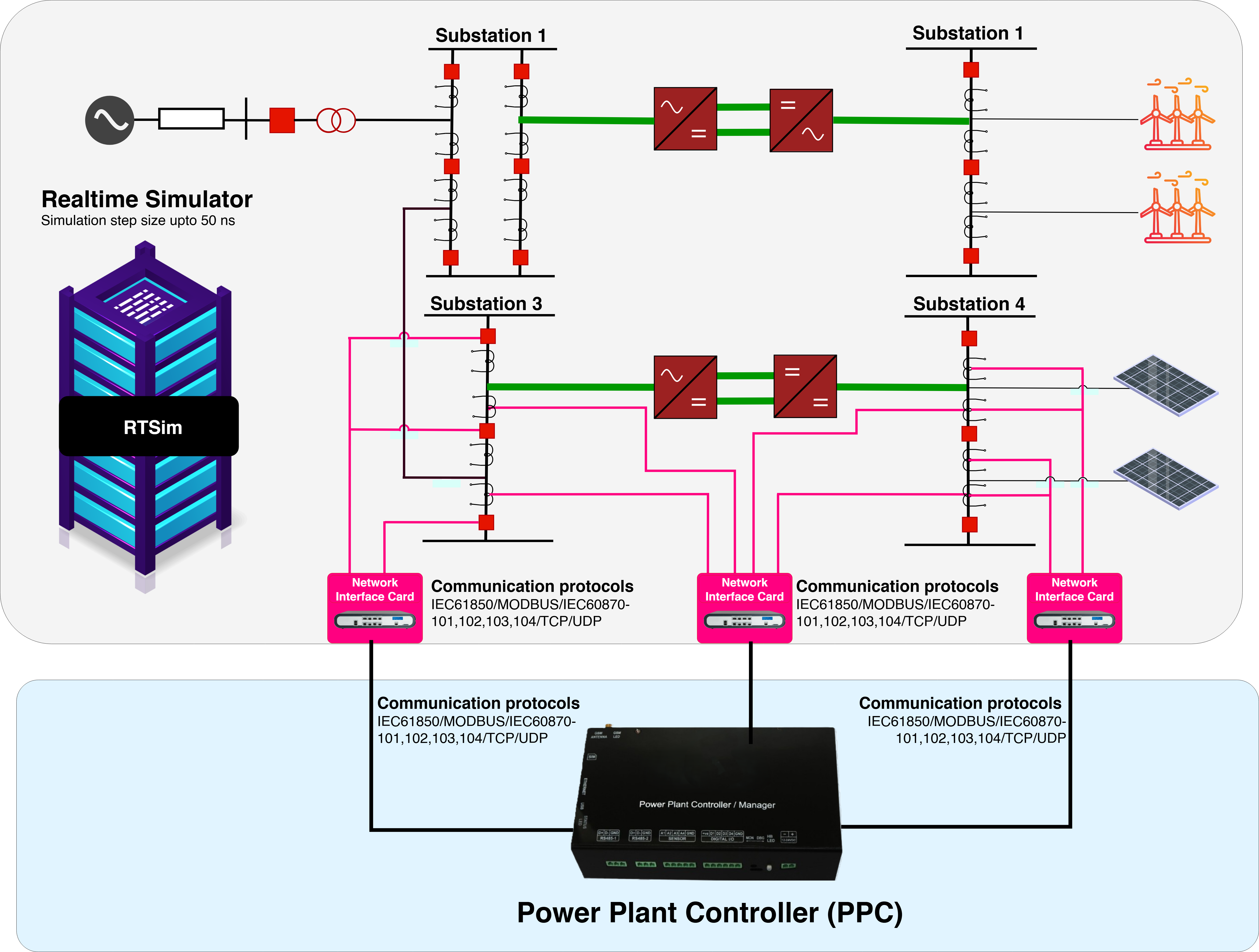
Analog & Digital I/O
- Simulated grid voltages, currents, and breaker statuses from RTSim are fed into the PPC’s input channels.
- The PPC sends control signals (e.g., reactive power setpoints, curtailment commands) back to RTSim to update plant behavior.
Communication Protocols
- PPCs often use IEC 61850 MMS/GOOSE, Modbus TCP, DNP3, or proprietary Ethernet protocols to communicate with inverters, SCADA systems, and grid interfaces.
- Support for these protocols in RTSim ensure real-time data exchange and interoperability testing.
DER Coordination
- RTSim emulates multiple inverter units, battery systems, and static compensators.
- The PPC must coordinate these resources to meet grid demands, optimize plant output, and maintain voltage/frequency stability.
Grid Event Injection
- RTSim Simulates voltage dips, frequency excursions, fault conditions, and grid disconnections.
- Validate PPC response for fault ride-through, reactive power support, and reconnection logic.
Setpoint Tracking & Ramp Control
- Test how the PPC handles active/reactive power setpoints from the grid operator, including ramp-rate limits and curtailment strategies.
Closed-Loop Feedback
- The PPC’s control actions dynamically influence the simulated plant and grid model in RTSim, enabling full closed-loop validation.
Why It Matters