

High Voltage Direct Current (HVDC) and Flexible Alternating Current Transmission Systems (FACTS) are essential for modern power grids—enhancing control, stability, and power transfer across long distances. Our realtime simulation platform, RTSim, enables engineers to study and test these power electronicsbased systems with unmatched precision.
By performing electromagnetic transient (EMT) simulations in real time, RTSim replicates the behavior of the physical grid as it operates. This allows engineers to interact with the simulation dynamically, enabling hardwareintheloop (HIL) testing of control systems, protection schemes, and converter technologies.
Solution Benefits
-
Reliable control system validation Manufacturers can test control systems against simulated grid conditions to ensure robust performance and reduce field deployment risks ensuring grid compatibility.
-
Converter and Grid interaction analysis
-
Protection and algorithm testing Simulate faults and observe system responses to validate new protection schemes and control algorithms.
-
Real-Time EMT Simulation Capture fast transients and switching dynamics with sub-millisecond time steps—essential for validating high-frequency converter behavior.
-
Operator training Provide a realistic, riskfree environment for training engineers and operators on complex system behavior.
-
Advanced converter support Realtime simulation is especially valuable for testing VSCs (Voltage Source Converters) and MMCs (Modular Multilevel Converters), enabling successful deployment of multiterminal and MMCbased HVDC projects.
Hardware-in-the-Loop (HIL) Testbed for HVDC and FACTS
Our RTSim platform seamlessly integrates with industrial digital controller platforms being used by HVDC and FACTS solution providers to enable closedloop testing of complex control schemes.
Simulated Electrical Network - HVDC & FACTS
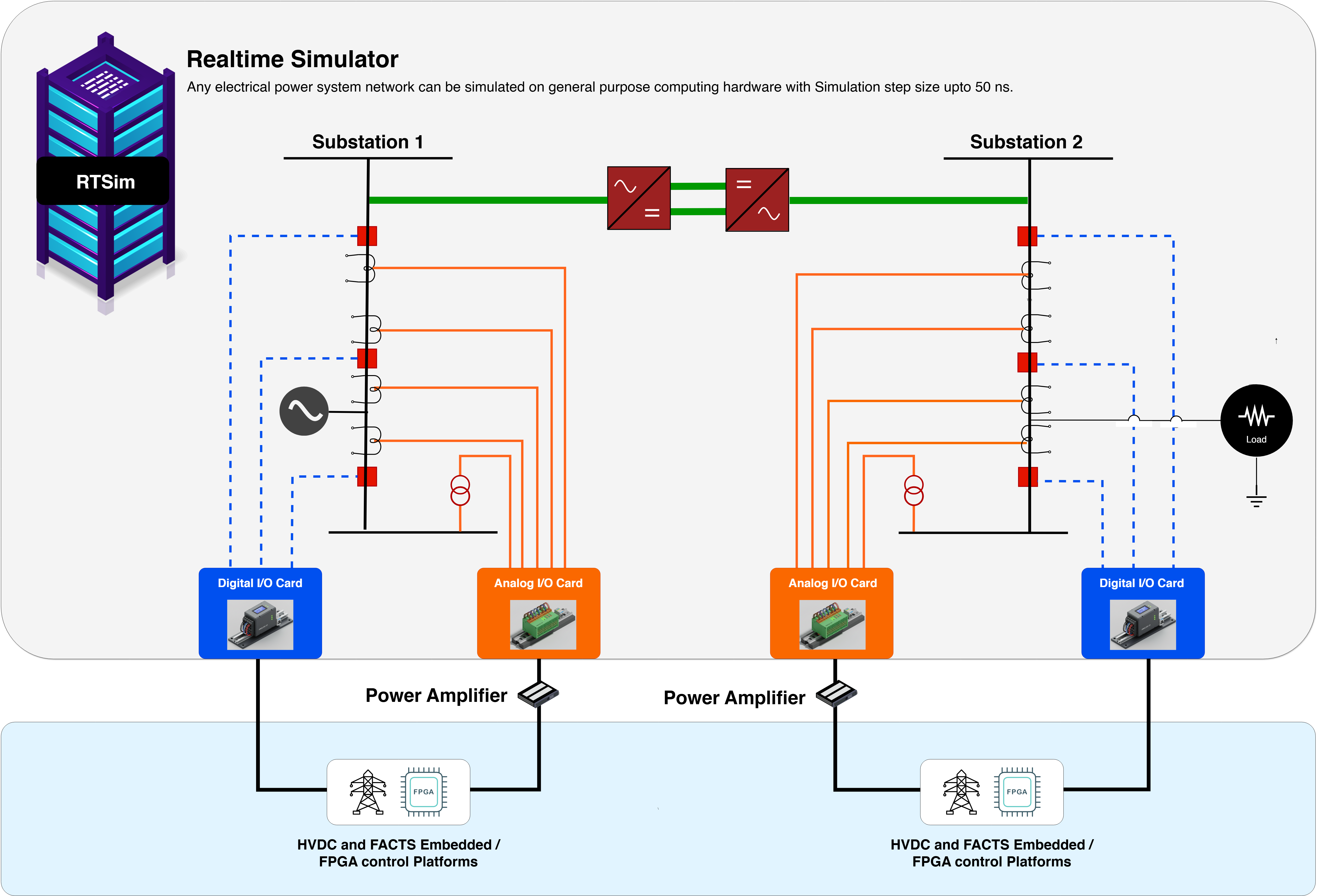
Analog & Digital I/O
- Our Real-time simulator RTSim generate analog signals (e.g., voltages, currents) and digital status indicators (e.g., breaker positions, fault flags) that mimic real-world sensor inputs.
- These are fed into the controller’s analog/digital input ports, allowing it to respond as if connected to a live grid.
PWM Capture & Injection
- For converter control validation, RTSIM captures PWM signals from the controller and uses them to drive the simulated power electronics.
- Alternatively, the simulator can inject PWM signals into the controller to test its response logic.
Communication Protocols
- Many HVDC and FACTS controllers rely on industrial protocols like Modbus, IEC 61850, DNP3, or proprietary Ethernet-based messaging.
- RTSIM seamlessly support these protocols to exchange control commands, measurements, and status updates in real time.
Timing & Synchronization
- RTSIM accurately interfaces at sub-millisecond/microseconds synchronization with the controllers.
- This ensures that control actions (e.g., firing angles, reactive power commands) are applied at the correct simulation time step.
Fault Injection & Response Capture
- RTSIM can inject faults (e.g., DC pole-to-ground, AC side short circuit) and observe how the controller reacts—whether it trips, reconfigures, or rides through.
- Trip signals, alarms, and control actions from the controller are fed back into the simulator to update the system state dynamically.
Why It Matters
Reduces commissioning risk by identifying integration issues early